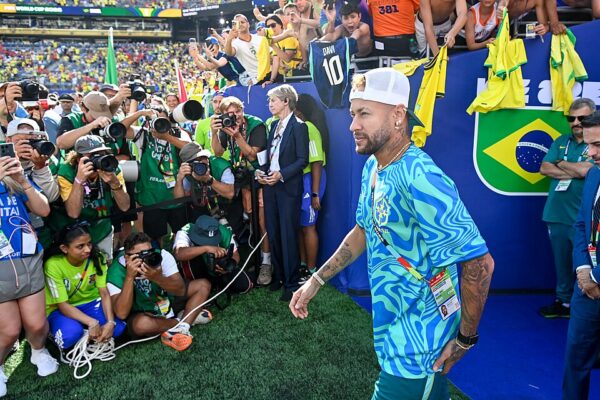
The most anticipated match of the Round of 16 arrives on Sunday night in East Rutherford, where Brazil face Norway at New York New Jersey Stadium with a quarter-final place, and control of the Golden Boot race, on the line.
Our Brazil vs Norway prediction is a 2-1 win for Brazil, but this is the tightest call of the round. Norway have never lost to Brazil in four all-time meetings, Erling Haaland has scored in every match he has started at this tournament, and the Seleção arrive with two of their most important creators ruled out.
Brazil’s path here has been dominant in stretches and nervy in moments. They won Group C with seven points, following an opening draw with Morocco with 3-0 wins over Haiti and Scotland, before needing a stoppage-time winner from substitute Gabriel Martinelli to see off Japan 2-1 in the Round of 32.
Carlo Ancelotti, the first non-Brazilian coach to lead Brazil at a World Cup, has now been dealt a double blow, with Raphinha confirmed out and Lucas Paquetá’s hamstring injury against Japan expected to end his tournament.
Norway are in the World Cup knockout stage for the first time since 1998, and they have been one of the stories of the tournament, 18 goals in four matches, a ruthless dismantling of their group, and an 86th-minute Haaland winner to eliminate Ivory Coast in the Round of 32.
And then there is the history: at France 98, Norway came from a goal down against Brazil with 12 minutes remaining to win 2-1 in one of the great World Cup group stage shocks.
Across four meetings, the record reads two Norway wins and two draws. Brazil have never beaten them.
The winner faces England or Mexico in the quarter-finals in Miami on July 11.

| Competition | FIFA World Cup 2026 - Round of 16 |
| Date & Time | Sun, 5 Jul 2026 · 21:00 WAT |
| Venue | New York New Jersey Stadium, East Rutherford |
| Key Battle | Erling Haaland vs Gabriel Magalhaes |
BRAZIL TEAM NEWS, INJURIES AND PREDICTED LINEUP
Carlo Ancelotti faces the most serious selection crisis of his tournament. Raphinha is confirmed out, having failed to recover from the hamstring injury sustained in the group stage, and Lucas Paquetá, withdrawn at half-time against Japan, appears to have suffered a tournament-ending hamstring injury of his own.
Together, the two absences strip Brazil of their primary creative link between midfield and attack. Casemiro was also taken off late against Japan, but the veteran is expected to be fit to start.
The response is likely to involve Matheus Cunha dropping into the No. 10 role vacated by Paquetá, with 18-year-old Endrick handed his first start of the tournament through the middle.
The Real Madrid forward made a strong impression when replacing Paquetá at half-time against Japan and appears ahead of Neymar in the pecking order for the vacancy.
Rayan continues on the right in Raphinha’s absence, with Martinelli, despite his last-gasp heroics against Japan, expected to remain an impact option from the bench.
The spine, at least, remains intact. Alisson has kept two clean sheets and saved 84.6% of the 13 shots he has faced, among the best records of any goalkeeper at the tournament.
Marquinhos captains a centre-back pairing with Gabriel Magalhães that has been Brazil’s foundation, and Bruno Guimarães has quietly been one of the players of the tournament, with four assists, only Michael Olise has more, including the exquisite pass that set up Martinelli’s winner against Japan.
The 34-year-old Casemiro, who scored against Japan, partners him in the double pivot but has looked increasingly leggy, and his duel with Martin Ødegaard is a genuine concern.
Vinicius Junior, who scored in every group game before a rare blank against Japan, now carries an even greater share of the attacking burden.
With four goals, the Golden Boot remains within reach, but he will need to rediscover his group stage sharpness quickly.
Brazil predicted lineup (4-3-3):
Alisson; Danilo, Marquinhos, Gabriel, Douglas Santos; Guimarães, Casemiro; Rayan, Cunha, Vinicius Junior; Endrick.

NORWAY TEAM NEWS, INJURIES AND PREDICTED LINEUP
Ståle Solbakken has almost a clean bill of health, with right-back Julian Ryerson’s thigh problem the only lingering doubt, and Marcus Pedersen has deputised so capably in his absence that the issue barely registers as a concern.
Everything, as ever, orbits Erling Haaland. The striker has five goals at this World Cup, braces against Iraq and Senegal in the group stage, then the 86th-minute winner that broke Ivory Coast in the Round of 32, and has scored in every single match he has started at the tournament.
His record of 59 goals in 52 international appearances entering the tournament has only grown more absurd, and on Sunday he faces a familiar adversary: Gabriel Magalhães, his fierce Premier League rival, in one of the most eagerly anticipated individual duels of the World Cup.
The pair have clashed repeatedly over the past two years in Arsenal-Manchester City meetings, and their confrontation now moves to the biggest stage in football.
Martin Ødegaard captains the side and remains the creative hub, his vision and control in the half-spaces are what turn Norway from a counter-attacking team into a genuinely balanced one.
Patrick Berg and Sander Berge provide the platform behind him, while Antonio Nusa’s directness and Alexander Sørloth’s aerial threat give the attack variety around Haaland’s movement.
Norway’s 18 goals in four matches make them, statistically, the most prolific side left in the tournament, and their resilience is proven, they responded to a heavily-rotated 4-1 defeat to France by immediately eliminating Ivory Coast.
This is Norway’s first knockout stage since 1998, and only goalkeeper Ørjan Nyland, now 35, had even been born the last time they faced, and beat, Brazil at a World Cup.
Norway predicted lineup (4-3-3):
Nyland; Pedersen, Ajer, Østigård, Wolfe; Berg, Ødegaard, Berge; Nusa, Haaland, Sørloth.
BRAZIL VS NORWAY HEAD-TO-HEAD RECORD
This is one of the strangest head-to-head records in international football: Norway have played Brazil four times and have never lost, winning twice and drawing twice.
The defining meeting came at the 1998 World Cup in France, when Norway trailed 1-0 with 12 minutes remaining in their final group game and produced a stunning comeback to win 2-1, a result that sent them into the knockout stage and remains one of the most celebrated nights in Norwegian football history. Sunday is their first meeting at a World Cup since.
For Brazil, the fixture carries a quiet psychological weight: they are the most successful nation in World Cup history, and Norway are one of the very few opponents they have simply never solved.
KEY PLAYER TO WATCH: ERLING HAALAND
Erling Haaland is the key player to watch because he has scored in every match he has started at this World Cup, and because the specific weakness Brazil carry into this fixture is the exact one he exists to punish.
Brazil’s high defensive line has been tested repeatedly this tournament, and without Paquetá’s control in midfield, transitions against them will come more frequently.
Haaland’s straight-line pace in behind is the most devastating single weapon in world football against exactly that structure.
Five goals in four appearances tell only part of the story; his movement stretches defences into shapes they do not want to hold, creating the space in which Ødegaard and Nusa operate.
His personal rivalry with Gabriel Magalhães, carried over from two seasons of Premier League hostilities, adds a combustible edge to a duel that may decide the entire match.
WHY BRAZIL CAN WIN
Even without Raphinha and Paquetá, Brazil’s squad depth is unmatched by anyone left in this half of the draw.
Vinicius Junior remains the most dangerous one-vs-one attacker at the tournament, Guimarães is creating at an elite level, and the bench options, Martinelli, Endrick, Neymar, would start for most nations here. Brazil have scored in every match they have played at this World Cup.
The defensive foundation is genuinely strong. Alisson is in outstanding form, and the Marquinhos-Gabriel partnership has conceded little all tournament.
Norway’s threat is concentrated and predictable in its pattern, if not in its execution; cut the supply into Haaland’s channels and force them to build in other ways, and Brazil’s superior technical quality across the remaining ten positions should tell over 90 minutes.
WHY NORWAY CAN WIN
Norway’s case is far stronger than the odds suggest. They have never lost to Brazil. They have scored 18 goals in four matches.
Haaland has scored in every start. And Brazil are missing the two players, Raphinha and Paquetá, most responsible for linking their play, with a 34-year-old Casemiro who has looked increasingly leggy asked to contain Ødegaard, one of the best creative midfielders in the world.
Brazil needed a 94th-minute winner to beat Japan, a side with a fraction of Norway’s attacking firepower.
If the Seleção defend with the same looseness on Sunday, Norway will not be as forgiving. The blueprint is simple, proven and 28 years old: stay in the match, and strike late.
Norway have already shown at this tournament, through Haaland’s 86th-minute winner against Ivory Coast, that they specialise in exactly that.
TACTICAL ANALYSIS: WHERE THE MATCH COULD BE WON
The defining tactical question is how high Brazil dare to hold their defensive line. Push up to compress the game and support their attack, and they expose the space in behind that Haaland devours.
Sit deeper to protect against his runs, and they concede the midfield territory in which Ødegaard picks passes apart. There is no comfortable answer, only a choice of risks.
Without Paquetá, Brazil’s build-up loses its most fluent connector, and their route to goal becomes more direct: Vinicius isolated against Pedersen or Ryerson on the left, Cunha’s physicality between the lines, and Guimarães’s range of passing from deep.
Norway will be content with that trade; their back three of central defenders behind a disciplined midfield screen is built to defend the box, and they will fancy Ajer and Østigård against a teenage centre-forward making his first start of the tournament.
The Casemiro-Ødegaard axis is where the match tilts. If the Brazilian veteran can stay close enough to disrupt Norway’s captain, Norway’s attack reduces to direct balls toward Haaland, dangerous, but manageable.
If Ødegaard finds space between the lines, Brazil’s centre-backs will spend the evening making impossible choices between stepping out and dropping off.
And looming over everything: set-pieces and late-game chaos. Both of these teams scored stoppage-time or near-stoppage-time winners in the Round of 32. Neither knows how to settle for what they have.
BRAZIL VS NORWAY BETTING TIPS
Based on both teams’ attacking form and defensive vulnerabilities, the recommended picks for Brazil vs Norway are:
– Both teams to score
– Over 2.5 goals
– Erling Haaland to score anytime
Norway have scored 18 goals in four matches and Haaland has scored in every start; Brazil have scored in every game they have played.
Neither defence has been watertight; Norway conceded four to France, Brazil have been breached in multiple matches, making this the most attacking matchup of the round on paper.
SCORE PREDICTION
This is the hardest match of the Round of 16 to call. Norway’s unbeaten history against Brazil, Haaland’s perfect scoring record when starting, and Brazil’s depleted creative midfield all point to a far tighter contest than the pre-match odds imply.
But Brazil’s individual quality across the pitch remains the difference. Vinicius Junior, stung by his blank against Japan and chasing the Golden Boot, is due a defining knockout performance, and Cunha’s movement between the lines should eventually unlock a Norway defence that will spend long stretches under pressure.
Haaland will likely continue his remarkable scoring run, but Brazil should edge a genuine contest, ending a 28-year-old hoodoo in the process.
Prediction: Brazil 2-1 Norway
FAQs
Who will win Brazil vs Norway?
MatchPreview predicts Brazil to win 2-1 in the closest call of the Round of 16, with their superior squad depth expected to narrowly overcome a Norway side that has never lost to Brazil and boasts the tournament’s most prolific attack.
Where is Brazil vs Norway being played?
The match is being played at New York New Jersey Stadium in East Rutherford, New Jersey, the venue that will also host the 2026 World Cup final.
What time is Brazil vs Norway?
The match kicks off on Sunday July 5 at 21:00 WAT (4:00 PM ET / 20:00 GMT).
Is Lucas Paquetá playing against Norway?
No. Paquetá was withdrawn at half-time against Japan with a hamstring injury that appears to have ended his tournament. Matheus Cunha is expected to drop into his No. 10 role, with Endrick likely to start up front.
Is Raphinha playing against Norway?
No. Raphinha is confirmed out, having failed to recover from the hamstring injury sustained during the group stage. Rayan continues in his place on the right wing.
Has Brazil ever beaten Norway?
No. In four all-time meetings, Norway have won twice and drawn twice, including a famous 2-1 comeback win at the 1998 World Cup, when they scored twice in the final 12 minutes. Sunday is their first meeting since.
How many goals has Erling Haaland scored at the 2026 World Cup?
Haaland has five goals, braces against Iraq and Senegal in the group stage, plus the 86th-minute winner against Ivory Coast in the Round of 32. He has scored in every match he has started at the tournament.
How many goals has Vinicius Junior scored at the 2026 World Cup?
Vinicius has four goals, scoring in every group stage game before a blank against Japan in the Round of 32. He sits three behind Golden Boot leader Lionel Messi.
Is Neymar starting against Norway?
Neymar is in the squad but has played minimal minutes at the tournament, and Endrick appears ahead of him for the vacant starting role. Neymar remains an option from the bench.
What happens if Brazil vs Norway is level after 90 minutes?
The match proceeds to 30 minutes of extra time, followed by a penalty shootout if still level.
Who does the winner of Brazil vs Norway play next?
The winner advances to the quarter-finals to face either England or Mexico in Miami on July 11.