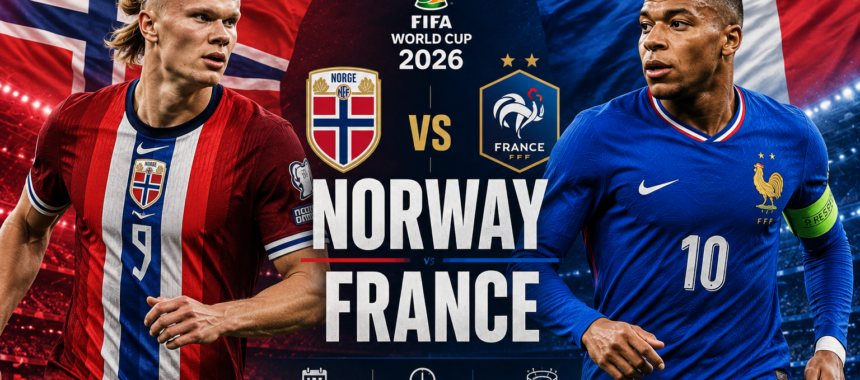
Norway and France are both qualified for the Round of 32 when they meet on June 26 in Foxborough, but the prize of Group I leadership means both teams will be desperate to win.
France are favourites and justifiably so. Two World Cup titles, the best individual player in the tournament in Kylian Mbappe and a defensive unit built around one of Europe’s finest central defensive partnerships in William Saliba and Dayot Upamecano.
But Norway have Erling Haaland, Martin Odegaard and a tactical system under Stale Solbakken that has been one of the most consistent and effective in European qualifying football.
They have beaten France’s level of opposition before, and they have the tactical tools to do it again in Foxborough.
Here is the blueprint for how Norway can win.
TACTIC 1: PRESS HIGH AND EARLY
France’s build-up play begins with Mike Maignan and the two centre-backs, Saliba and Upamecano, looking to play out from the back and find Tchouameni or Rabiot in central midfield.
Norway’s best chance of disrupting this pattern is to press high and aggressively from the first whistle.
If Solbakken can organise a front three of Haaland, Sorloth and Nusa to press in coordinated triggers, forcing Saliba or Upamecano to play longer balls rather than their preferred short combinations, France lose the composure that underpins their entire offensive structure.
The key trigger for Norway’s press is when Maignan receives the ball from a goal kick or back pass. That is the moment when Haaland presses the centre-back who receives and Sorloth covers the other, forcing France to play sideways or long.
Norway’s midfielders, Odegaard, Berge and Thorsby, must move in synchrony to cut off the horizontal passes that allow France to escape the press.
This worked effectively against Senegal, who play a similar possession-based style. France are technically better, but the pressing trigger remains the same.
TACTIC 2: EXPLOIT THE SPACE BEHIND THEO HERNANDEZ
France’s left-back Theo Hernandez is one of the most attacking fullbacks in world football. His pace and ambition going forward are outstanding, but those qualities create the exact vulnerability that Norway’s Antonio Nusa can exploit.
When Hernandez pushes forward, which he does consistently, particularly in the first 30 minutes of matches when France are trying to establish dominance, the space behind him becomes a four-on-three for Norway’s right side.
Nusa has the pace to run in behind, Ryerson has the quality to find him with a pass from the right back position, and Odegaard can arrive late into that same channel from central midfield.
France scored three goals against Senegal in exactly this way, quick transitions through the space behind the opposition’s attacking fullback. Norway must do the same to Hernandez.
The tactical instruction for Nusa is simple: when Hernandez pushes forward, make the diagonal run in behind him immediately and demand the ball from Ryerson or Odegaard.
One run in behind that stretches Saliba across from his central position creates the gap for Haaland to exploit on the opposite side.
TACTIC 3: TARGET UPAMECANO WITH HAALAND’S PHYSICALITY
Dayot Upamecano is an excellent central defender but he has a documented weakness when physical strikers run at him and force him to defend on the turn.
Bayern Munich’s opponents in the Champions League have consistently targeted him with direct runners, and while he manages this well on most occasions, it remains his most exploitable defensive characteristic.
Norway’s tactical instruction for Haaland in this match should be simple: always arrive running rather than standing.
The moment Haaland receives the ball stationary, Upamecano’s composure allows him to defend without stress. The moment he receives it in behind, running toward goal, Upamecano’s ability to track back and defend while turning is significantly reduced.
Odegaard’s role in creating this situation is critical. His ability to play the ball in behind the defensive line, the same pass that released Haaland repeatedly against Senegal, must be Norway’s most frequently practiced offensive pattern.
If Odegaard can find that pass three or four times in the first 45 minutes, Upamecano will begin dropping deeper, which creates space between the lines that Sorloth and the midfield runners can exploit.
TACTIC 4: BE COMPACT WITHOUT THE BALL AND TRANSITION QUICKLY
Norway cannot afford to attack carelessly against France. When they lose the ball in advanced positions, France’s transition speed, through Mbappe, Olise and Thuram, is one of the fastest in world football.
Solbakken must organise Norway to defend in a mid-block when they do not have the ball, sitting in a compact 4-4-2 shape that reduces the space between the lines and forces France to play around them rather than through them.
This is not a negative approach, it is a tactical necessity against a team with Mbappe’s transition speed.
The key instruction is for Odegaard and Berge to track back into the defensive shape immediately when possession is lost.
If those two players are ahead of the ball when France transition, Mbappe and Olise have the space to create a three-on-three or four-on-four against Norway’s backline, a situation that consistently leads to goals at this level.
When Norway win the ball back in the defensive block, the transition must be immediate and direct. Haaland must make his run before the ball is recovered, so that the moment Norway’s defenders gain possession, the pass forward is available.
THE VERDICT: IS AN UPSET POSSIBLE?
Yes. However, Norway needs to execute all four of these tactical elements simultaneously, and they need to score first.
The most important single factor is the opening 20 minutes. If Norway can press France into mistakes, create two or three dangerous situations from those turnovers and score before France settle into their rhythm, the tactical dynamic of the match changes completely.
A France team chasing a goal against a deep, organised Norway block is a very different challenge from a France team controlling a match from 1-0 up.
Norway has the players to execute this blueprint. Haaland provides the goal threat, Odegaard provides the creativity, Nusa provides the pace and Berge and Thorsby provide the defensive discipline.
The question is whether Solbakken can get the tactical instructions executed from the first whistle in a tournament environment where the occasion and the quality of the opponent creates enormous psychological pressure.
If Norway can win this match, it will be one of the most tactically impressive victories in their football history.
FAQs
What formation will Norway use against France?
Norway are expected to use their preferred 4-3-3 formation with Haaland as the central striker, Sorloth and Nusa wide and Odegaard, Berge and Thorsby in a three-man midfield.
What are France’s tactical weaknesses?
France’s most exploitable tactical characteristic is the space behind Theo Hernandez when he pushes forward, and Upamecano’s relative vulnerability when physical strikers run at him on the turn. Norway’s tactical plan must target both of these areas.
Can Norway qualify as Group I winners?
Yes. If Norway beat France on June 26, they win Group I outright. Both teams are already qualified for the Round of 32, so the match is a battle for top spot and the more favourable knockout path that comes with it.
When is Norway vs France?
Norway vs France takes place at Gillette Stadium in Foxborough, Massachusetts on June 26 at 20:00 WAT (15:00 ET).