The numbers from England’s 0-0 draw with Ghana on Matchday 2 of the 2026 World Cup are genuinely extraordinary, and not in the way England supporters would want.
78.9% possession. The highest recorded by any side that failed to score in World Cup history since 1966. 19 shots, the most England have had without scoring at a World Cup for 24 years. Just three on target. And the best chance of the match, a one-on-one for Harry Kane, skied into the Boston night sky.
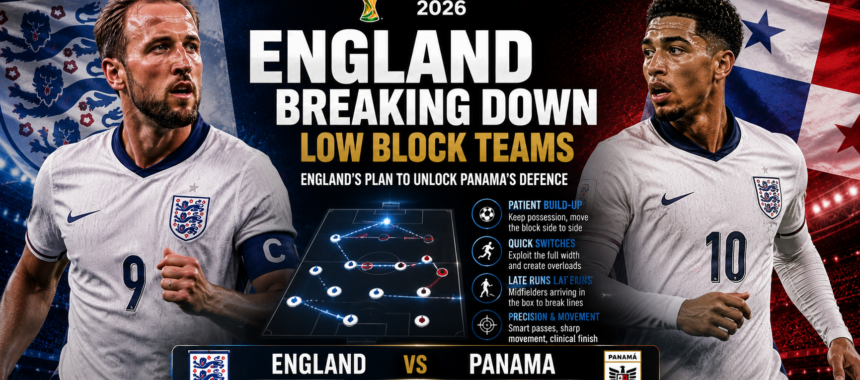
Against Panama on Saturday, Tuchel has the opportunity to fix what went wrong in Boston. But the deeper question, how England break down a deep, organised defensive block, will not go away after Panama.
It will return in the knockout rounds, potentially against better teams defending with the same discipline as Ghana.
WHAT WENT WRONG AGAINST GHANA
The fundamental problem was not England’s ability to create chances. They created plenty, 2.09 expected goals from 19 shots is a reasonable return, and the creation of those chances involved good combinations and purposeful movement in the final third.
The problem was threefold.
First, England were too predictable in how they attacked. Ghana’s defensive block was set in a 4-4-2 shape, and England’s wide players consistently tried to drive inside rather than staying wide and delivering into the box.
Panama and most knockout opponents will organise similarly, and England need more variety, including crosses, cutbacks, shots from the second line, to break that shape down.
Second, Bellingham’s position was too central and too restricted. Tuchel’s deployment kept Bellingham in a linking role rather than a driving one, arriving into the penalty area late was Bellingham’s most effective contribution against Croatia, and that element was absent against Ghana.
Against Panama, giving Bellingham the licence to arrive late from deep into the box could create the kind of diagonal runs that defensive blocks consistently struggle to track.
Third, the absence of a genuine width threat hurt England severely. With Saka managing his Achilles and only featuring in limited capacity, England’s right side, where Noni Madueke operated, lacked the directness and unpredictability that Ghana’s left flank needed to address. Madueke is technically capable but does not carry the same automatic defensive respect that Saka generates, and Ghana exploited that by pushing their right-back higher against him.

WHAT TUCHEL MUST DO AGAINST PANAMA
Panama will set up exactly as Ghana did, a deep 4-4-2 block, compact, physical, designed to frustrate England’s build-up and limit the space Kane operates in.
The difference is that Panama have been significantly more porous in this tournament. They have conceded two goals in two matches without scoring, their defensive organisation is less sophisticated than Ghana’s, and they carry less of the physicality that Ghana used to win second balls in midfield.
Three specific tactical adjustments could unlock Panama and, more importantly, prepare England for what comes next.
The first is deploying Declan Rice as a box-to-box threat rather than a pure defensive shield. Rice has created more chances than any other player across the first two matchdays of this tournament, ten in total, which reflects his ability to drive forward, pick out runners and arrive in dangerous positions from deep.
Against Panama’s midfield of Godoy and Carrasquilla, Rice can advance more freely than he could against Ghana because Panama’s counter-attacking threat is minimal.
Giving Rice the licence to push into advanced positions, overlapping Bellingham when the ball is wide, creates overloads that Panama’s compact block cannot cover.
The second is using cutbacks rather than crosses. Panama’s central defenders are organised and physical, which means balls into the penalty area inviting aerial duels are manageable for them.
What defensive blocks struggle to deal with is the ball pulled back from the by-line to a runner arriving from the edge of the penalty area, a movement that requires defenders to turn, track and close simultaneously.
England’s wide players must be instructed to drive to the by-line first and only cut back, rather than crossing early from wide positions.
The third is giving Kobbie Mainoo his opportunity. If Rice is rested or managed carefully, which the yellow card situation and his 64-game season supports, Mainoo as his replacement changes England’s midfield texture significantly.
The Manchester United midfielder’s ability to receive the ball under pressure, turn in tight spaces and find teammates in dangerous positions between the lines is exactly the quality needed against a team defending deep.
His creative tempo is different from Rice’s industry, and that difference could be the unlocking element England needs.
THE BIGGER PICTURE FOR THE KNOCKOUT ROUNDS
Panama is a dress rehearsal. The real test of whether England have solved their low block problem comes in the Round of 32 and beyond.
England’s likely knockout path, if they win Group L, takes them through a third-placed team in the Round of 32, which could be any of eight sides from across the tournament.
Many of those sides will defend the same way Ghana did. And if England progress further, they could face Morocco, Argentina or France, teams that are tactically sophisticated enough to sit deep and counter.
The Croatia performance showed England at their attacking best, direct, confident, multiple goal routes, Kane and Bellingham both decisive.
Tuchel needs that version of England against Panama. Not just for the result, but for the confidence and clarity it provides heading into the knockout stage.
FAQs
Why did England struggle to score against Ghana?
England had 78.9% possession and 19 shots but could not score because Ghana’s 4-4-2 defensive block was well-organised and England were too predictable in how they attacked, lacking variety in their final ball, with Bellingham too restricted and the right flank too predictable without Saka’s direct threat.
What is England’s tactical setup under Thomas Tuchel?
Tuchel uses a 4-2-3-1 or 4-3-3 depending on the opposition, with Rice and a second central midfielder providing the defensive base and Bellingham operating in the attacking third. Kane leads the line with wide forwards providing width and delivery.
How will England set up against Panama?
England are expected to rotate, with Rice and potentially James rested due to injury and yellow card accumulation. Mainoo is likely to feature in midfield. Tuchel will want a confident, high-scoring performance to rebuild attacking momentum before the knockout rounds.
When is Panama vs England?
Panama vs England is at 22:00 WAT (17:00 ET) on June 27 at MetLife Stadium in East Rutherford, New Jersey.